


Tuesday
It’s getting late.
On the sofa next to me, The Dog is snoring. I’ll need to wake him up for our morning walk or I’ll run out of time for a shower.
The distance to the mailbox and back is only a mile, but these days it feels more like five. The Dog, though loyal, walks so slow now, I have to pad my morning ritual with extra minutes. We don’t converse much on the first half of the journey. We start and stop. We assess. He smells and I listen. This week, the Bewick’s Wrens have begun singing again, flicks from the Northern Flickers are echoing from the tops of the alders.
It’s getting late in the month of February, and the birds know it.
After too many stops for my taste, The Dog and I finally arrive at the mailbox. He wants to continue on, down the road for...who knows how long. One of these mornings, when I have nothing to do, I’ll let him keep walking and see if he ever decides to turn around. But I don’t have time today.
I tug on the leash to turn him around. He looks at me, as if to say: You’re not serious?
I am serious.
“Some of us have things to do today,” I say.
He listens, knows what I have said, but does not acknowledge my statement. His brows furrow. I tug on the leash again. He bears down a little but finally relents when I encourage him with an excited tone—as if I am aware of something amazing up ahead on the road we just walked down. Thirteen human years and a tumor on the left adrenal gland will slow a dog down. Even a great one.
On the half mile return back up, The Dog somehow walks even slower than he did on the way down. I slow my steps to match his lower gear, to no avail. When I decelerate, he decelerates further. This glacial pace aggravates my sense of movement, my sense of an hour. If we continue slowing down, we’ll start going back in time.
“You must be able to walk faster than this!” I plead with him.
There is no response—not even a glance up. He is completely ignoring me now. My Beloved insists that The Dog doesn’t comprehend what I’m saying, but all three of us know that’s not true.
After we move a few feet, The Dog takes up a fascination with a one inch patch of the ground. He nuzzles his nose into the forest floor, and I can tell he won’t raise his head until he gets to the bottom of whatever recently occurred there.
It is getting late, and we have at least a quarter mile to go.
While The Dog continues his investigation, I talk myself out of getting irritated. I say to myself, Take advantage of the pause to look for what’s going on out here. I notice the tiny leaf-buds jutting out of the ends of long, spindly salmonberry branches. Behind them, stoic elders are releasing the first fountains of their bright green leaves. The color looks almost neon next to the ruddy dark of their thick branches. So soon? I say out loud. It wasn’t that long ago the understory donated their entire summer bounty to the worms.
When we finally make it back to the house, I notice that the peonies are offering gleaming red, one-inch buds at the feet of last year’s stalks. It looks as if they have painted their toenails. I stop and touch them. In reverence. In disbelief. So soon?
So soon. And yet, it is getting even later.
Wednesday
“Two? Or three?
—“Two.”
“Three? Or four?”
—“Can I see three again?”
“Of course.”
—“Three.”
This might seem like an eye exam, as if there are no wrong answers, but I’m not so sure. Is there a pattern? Do my overly-confident answers betray an internal contraction because that would explain a lot about my life. Dr. Campbell is so professional, so personable, he would never say one way or the other.
I know he is a skier so I ask if he’s watching the Olympics.
“Yes, but every time I turn it on it’s curling.”
I’m about to say how much I love to watch curling; how, in my mind, curling is second in line in terms of badassery only to the biathlon, which, as a sport, is Absolute Badassery.
He smiles and I focus on his white-blue teeth, “Remember the pandemic, when the only thing on television was cornhole?”
I don’t remember this.
“Now about your dry eyes,” he says. “I don’t think we’ve ever done a test to see how well your eyes are producing tears.”
Do I need a test for this? I am a good crier. Been doing it all my life. But yes, let’s do this because my eyes are excruciatingly dry, and enough so that I even mention it to him, which is unlike me.
I might cry well but I complain terribly.
Dr. Campbell opens a drawer and pulls out a small envelope. He opens it to reveal two small, thin paper strips, explaining that he’ll put one in each eye for five minutes.
I’m wondering what else Dr. Campbell has in that drawer. Does he have any test strips to measure the human capacity to feel compassion? Those could be useful. We need to dole those tests out to people running the show on this planet.
After putting another mysterious liquid in my eyes, Dr. Campbell inserts one strip in the left eye, the other in the right. “This will tell us the amount of moisture each eye’s tear duct is producing. There’s a scale up to 20mm, with 15 being average and healthy.”
He tells me to close my eyes and “daydream for the next five minutes.”
I should get an A++ on this test.
The timer rings. Five minutes are over, and unless I have misunderstood, I don’t feel any tears in my eyes. Five minutes pass quickly when you’re daydreaming. I need to remember this tomorrow morning when I’m walking The Dog.
Dr. Campbell comes over to the chair to remove the thin white strips.
“Wow,” he says, removing them. “Your left eye produced 1mm and your right, 0.”
I hear the numbers, and I’m not sure I understand them.
“Do you mean, I am literally out of tears?” I ask?
“Well, the test has verified what you’re feeling. That much is certain.”
Thursday
The Dog and I walk slowly, tearlessly down to the mailbox.
How can I be out of tears? I’m going to need them. It’s getting late in my life; it’s getting late on the World Clock. I’m going to need tears of empathy, strength, resolve to face how fast humanity is undergoing—whatever this is that’s happening right now.
The Dog is keeping up a decent clip today. I thank him for it.
At the mailbox, he doesn’t argue with my tug to turn around. Again, a good clip on the way back. Again, I thank him. As we approach the entrance to the trail, I wait for him to veer left, to avoid it, as he usually does, but he’s caught scent of a coyote so he picks up his pace and leads me down the path. Now we are walking at my preferred speed—Manhattan style.
On the trail, the Christmas ornaments are still hanging on the trees. I haven’t had the heart to remove them—the gift of their bright red burst cheers me up. It’s getting too late to leave them, but maybe just one more weekend.
The Dog tugs at the leash, and wants to lead me down Victoria Lane, but I force him to turn left up Paw Print Path.
“Some of us have jobs,” I tell him. “Unlike yourself, I don’t get to sit on the sofa all day.”
In his mind, sleeping on the sofa is his job.
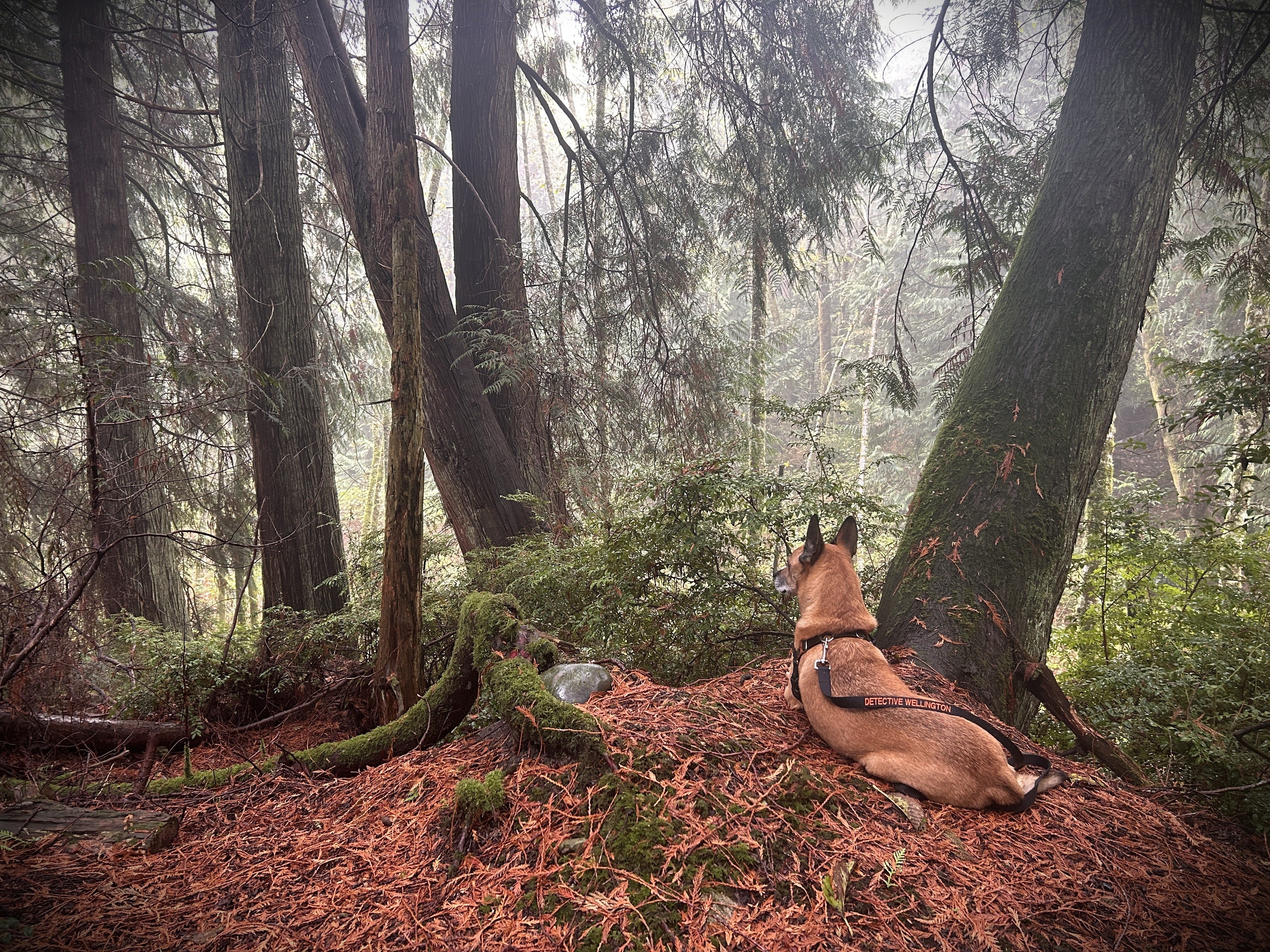
At ‘The Lookout’ The Dog pauses, lays down. That coyote tracking wore him out. It’s getting late, but I let him lay there, sniffing the air for a while. I remember what the vet said to me last August, after he found the tumor: “Enjoy the time you have with him”
It’s quite likely this will be the last spring with The Dog. My eyes well up thinking about it.
So, I’m not entirely out of tears.
I drop the leash and let him lay down. His nostrils pulse. He looks happy.
It’s getting late but I still have time.
-Thank you for reading.
{| AC
Beautiful. It allowed me to demonstrate that my own tear ducts are still working.
Oh what a journey he has had! He is very thankful no doubt. Beautiful…and my tear ducts are working just fine. ❤️💙